


Page 96 - Demo
P. 96
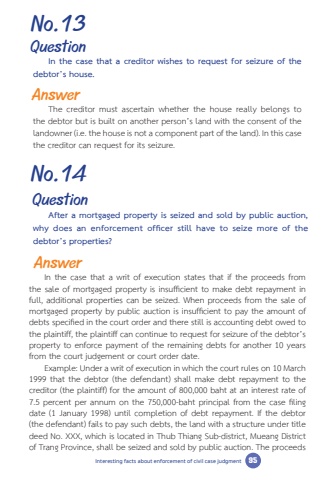
Interesting facts about enforcement of civil case judgment95The creditor must ascertain whether the house really belongs tothe debtor but is built on another person%u2019s land with the consent of the landowner (i.e. the house is not a component part of the land). In this case the creditor can request for its seizure. In the case that a writ of execution states that if the proceeds from thesaleofmortgagedpropertyisinsufficienttomakedebtrepaymentinfull, additional properties can be seized. When proceeds from the sale of mortgagedpropertybypublicauctionisinsufficienttopaytheamountofdebtsspecifiedinthecourtorderandtherestillisaccountingdebtowedtothe plaintiff, the plaintiff can continue to request for seizure of the debtor%u2019s property to enforce payment of the remaining debts for another 10 years from the court judgement or court order date. Example: Under a writ of execution in which the court rules on 10 March 1999 that the debtor (the defendant) shall make debt repayment to the creditor (the plaintiff) for the amount of 800,000 baht at an interest rate of 7.5percentperannumonthe750,000-bahtprincipalfromthecasefilingdate (1 January 1998) until completion of debt repayment. If the debtor (the defendant) fails to pay such debts, the land with a structure under title deed No. XXX, which is located in Thub Thiang Sub-district, Mueang District of Trang Province, shall be seized and sold by public auction. The proceeds In the case that a creditor wishes to request for seizure of the debtor%u2019s house.After a mortgaged property is seized and sold by public auction, why does an enforcement officer still have to seize more of the debtor%u2019s properties? No.13No.14QuestionAnswerQuestionAnswer


